Architectural Decision Records Review Process
This document outlines the architectural review process for the Empower project, which will be used to evaluate Architecture Decision Records (ADRs) proposed for changes to the project's architectural design and components. These changes are crucial for enabling the development of new features and capabilities.
Architectural modifications can have a significant impact on the workload of our infrastructure team. Therefore, it is essential that they are promptly reviewed, approved, rejected, or accepted with recommended adjustments by the review board to ensure continuous progress on planned feature deliverables.
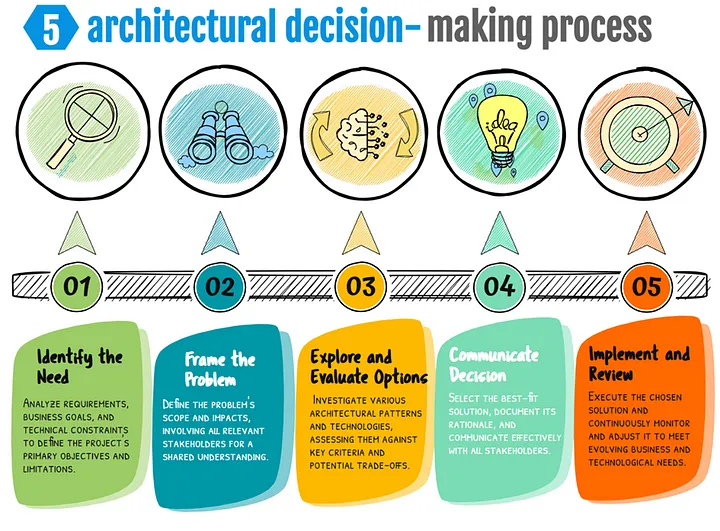
ADR Specific Details
- The ADR document is available on the Empower internal wiki, and each ADR will be assigned a unique number for identification.
- Find the link to location where all the ADRs will be hosted on Empower internal wiki
Link to ADRs Wiki section - Each ADR document will include a problem definition, along with links to the relevant documents necessary for making an informed architectural decision.
Objectives for Architectural review board
- The Architectural Review Board evaluates decisions that significantly impact the overall product or multiple teams (pods).
- Members of the review board will be invited to a meeting, or details will be shared async to discuss architectural topics and determine whether to approve, reject, or approve with conditions or recommended changes.
- ADR review meetings will be organized at a 2-week cadence where any new ADR can be introduced, and existing ADR can be reviewed or discussed for decision.
- Any questions can be asked async by the ADR reviewers which will be helpful in taking a decision.
- In situations where any member of ADR review board is the ADR owner, that team member will not participate in the review process.
- Decisions on the approval or rejection of an ADR will be made by a simple majority vote among review board members, especially in cases where there is a difference of opinion to resolve a deadlock.
- It will be incumbent upon the ADR owner to share all required details, architectural designs and all the relevant documents with review board to take appropriate action on ADR.
- ADR reviewers should share their decision within span of 2 week so that engineering team can move ahead with the decision.
- An ADR decision can be vetoed at VP level in very specific scenarios, this will only be used in exceptional cases.
*Change in business requirements based on the ADR or external factors that were late arriving, or inadequately considered.*Shift in Product roadmap priorities or business priorities that do not match or are in conflict with the ADR.*The proposed solution has a significant capital or operational cost which may not be justifiable. (Non-budgeted projects may need to be deferred if the business can't descope other commitments.)
*Policy or procedure compliance with respect to vendors (e.g. external tools), security (ISO / IT), this process, or any other corporate policy - In situation of rejection of ADR, a written explanation will to be added to ADR ticket to share details on nature of non-approval.
Essentials of Decision Making
Quantitative Metrics: These include performance benchmarks and financial costs, crucial for objective decision-making.
Qualitative Attributes: Subjective yet vital aspects like developer expertise and organizational culture ensure the architecture’s compatibility with the organizational context.
Cost and Risk Analysis: It’s important to evaluate the long-term financial and risk implications of architectural choices.
Making the Business Case: Translating architectural decisions into business benefits is essential for stakeholder buy-in.
Trade-off Analysis: This process balances different quantitative and qualitative factors according to project priorities.
Holistic Framework: A comprehensive decision-making framework integrates technical and business considerations, encompassing immediate needs and future strategies.
List of board members to approve an ADR
| Board Members |
|---|
| Andrew Fedin |
| Ashish Tripathi |
| Don Scott or Dedicated PM |
| Doug Coen |
| Evan Sotos |
| Jan Nelson |
| Kevin Curry |
| Michael Popp |
| Thomas Wynne |
Substitution can be suggested by board members on their behalf, if they find another team member is more closely working on the initiative associated an ADR.
Summary
- The ARDs will be documented on our internal wiki, including links to all supporting documents and diagrams used during the ADR review process.
- Steps to create an ADR on the wiki ADRs Creation Steps
- Team members may be delegated the responsibility to review specific ADRs, where appropriate, to expedite the process.
- After a decision is made on an ADR, a summary outlining the decision criteria will be added to the same wiki page.